

Document flow
Invoices, contracts and delivery notes: extract, check, route, archive.
Four systems cover most of the demand we see. Each one ships with a review step, because a wrong invoice sent automatically costs more than a slow one.
Invoices, contracts and delivery notes: extract, check, route, archive.
Answers over your own documents, with the page and the paragraph behind every claim.
Sorting, draft replies and the escalation rules your support team already uses.
Numbers pulled from CRM, ERP and spreadsheets into one table on a schedule.
A pilot runs on one workflow, one team and real documents. It lasts two to three weeks and ends with three numbers: accuracy on a test set, hours saved per week, and the cost per document. If the numbers do not hold, the project stops there and you keep the report. The same pilot method applies to RAG development over a document base.
Only after a pilot does the rollout make sense. Rollout adds the review queue, the access rules, the monitoring and the fallback for the day the model or the API fails.

Five stages, each with a written result.
We watch the process, count the steps and the exceptions, then name the slowest part.
Where the documents live, who may read them, what the model is allowed to see.
One workflow, real data, a test set and a written accuracy result.
Review queue, alerts, access rules and a fallback path.
Prompts, rules and documentation, so your team can change a field without us.
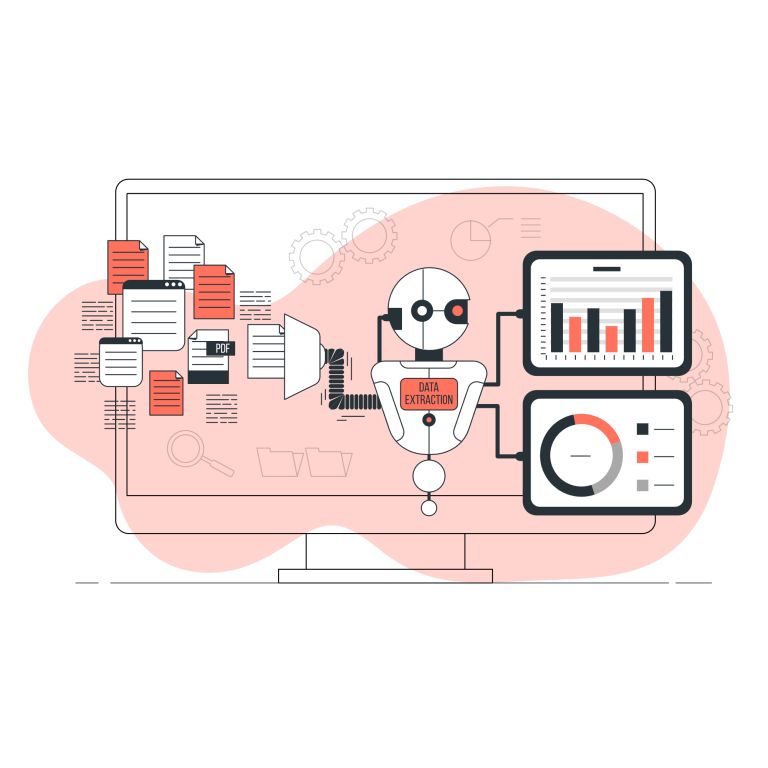
Automation pays when the input is repetitive, the rules are written and a person can check the output in seconds. It does not pay for one-off reports, for decisions with legal weight, or for processes nobody can describe in writing.
The cost model follows the same logic. A pilot starts at 600 USD, an integration with CRM or ERP reaches 3 000 USD, and a document search system runs from 4 000 to 15 000 USD. Hourly work sits at 35 to 55 USD. Current ranges are on the pricing page, and the NIST AI risk framework is the checklist we keep in mind.

Four lines we do not cross, whatever the pilot shows.
Invoices, contracts and legal notices always pass a human step before they leave the system.
A model is wrong sometimes. The review queue and the fallback are part of the build, not an extra.
If the process cannot be written on one page, it is not ready for automation.
Client documents stay in your accounts, with your access rules. If a provider cannot sign the terms you need, we stop the project.
What clients ask before the pilot.